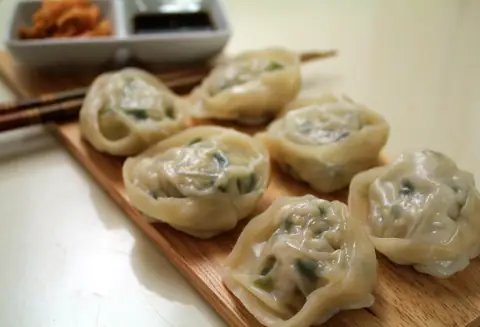
만두Mandu (Korean Dumplings)
look for this on the menu
- man-du
- Not spicy
- Street food
Your food preferences
Tell us what you avoid to see if this fits you.
Set my needsDumplings filled with meat, tofu, glass noodles and vegetables; steamed, boiled or pan-fried.
Usual recipe onlyEverything on this page is the typical recipe. It never tells you a restaurant's dish is safe; for that, check the restaurant menu or ask staff.
What's in it
6 pieces- Wheat wrapper
- Ground porkand/or beef
- Tofu
- Glass noodles
- Cabbage, chives
- Kimchiin kimchi mandu
Pieces follow the usual recipe. Each restaurant can differ.
Hidden ingredients
Kimchi mandu (김치만두) usually also has fish sauce or shrimp from the kimchi. Shrimp mandu exists too.
Hidden ingredients in its usual recipe
Common allergens
Allergy-related ingredients
- usually: Wheat usually
- usually: Soy usually
- sometimes: Sesame sometimes
- sometimes: Egg sometimes
- sometimes: Fish sometimes
- sometimes: Shrimp & crab sometimes
Dietary restrictions (meat, alcohol, garlic and onion family, honey)
- usually: Pork usually
- usually: Garlic, onion, scallion & chives usually
- sometimes: Beef sometimes
Gluten (for gluten avoidance; a wheat allergy is listed above)
- usually: Gluten (wheat, barley, rye) usually
Cross-contact: shared oil, grills and tools are not covered by any recipe. Ask staff.
- Not vegan as usually made.
- Not vegetarian as usually made.
- Some restaurants may offer ingredient changes. Ask before ordering.Removing a visible ingredient does not guarantee that sauces, stock, seasonings or shared equipment are free from it.
Good to know
Some shops have vegetable mandu (야채만두), but many 'vegetable' ones still contain pork.
General tip, not based on your settings. Your own order sentence is under "Questions to ask staff". Removing a visible ingredient does not guarantee that sauces, stock, seasonings or shared equipment are free from it.
Questions to ask staff
Point to the Korean. Set what you avoid to get your own questions.
밀 들어가나요?
Is there wheat in it? (core: part of the base, broth or main ingredient)
돼지고기 들어가나요?
Is there pork in it? (core: part of the base, broth or main ingredient)
콩 들어가나요?
Is there soy in it? (core: part of the base, broth or main ingredient)
마늘·양파·파·부추 들어가나요?
Is there garlic, onion, scallion, chives in it? (core: part of the base, broth or main ingredient)
글루텐 들어가나요?
Is there gluten in it? (core: part of the base, broth or main ingredient)
소고기 들어가나요?
Is there beef in it? (in some recipes; depends on the kitchen)
참깨, 참기름 들어가나요?
Is there sesame in it? (in some recipes; depends on the kitchen)
달걀 들어가나요?
Is there egg in it? (in some recipes; depends on the kitchen)
생선 들어가나요?
Is there fish in it? (in some recipes; depends on the kitchen)
새우, 게 들어가나요?
Is there shrimp/crab in it? (in some recipes; depends on the kitchen)
국물이나 양념에도 들어가나요?
Is it in the broth or the seasoning too?
These are general questions about this dish. Set what you avoid to get a Korean order sentence for you. We never ask staff to leave out things you didn't choose. Set my needs
Open my staff cardRelated dishes
Where to find it
No restaurant menus with official allergen information for this dish yet.